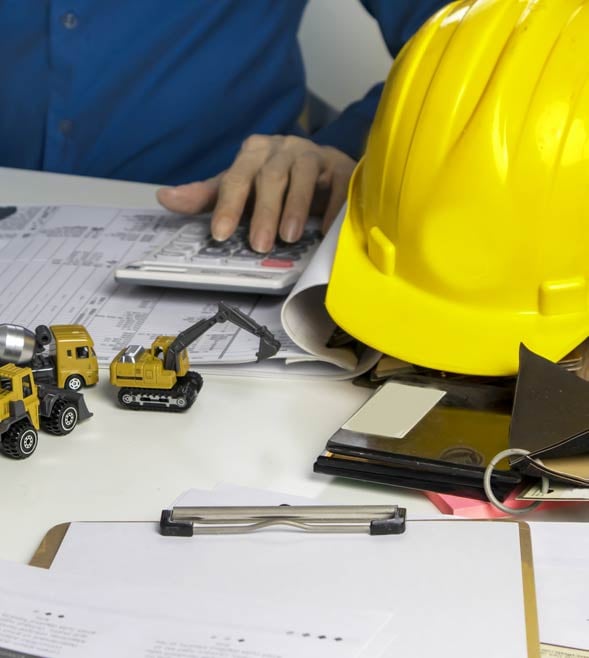
It’s no secret the past few years have been tough for the construction industry. Unfortunately, it’s not going to get any easier in a hurry.
Contents
The Iran oil crisis means that fuel costs have already risen, and materials have started to become more expensive. Further cost escalations are on the horizon as the full heft of the crisis works its way through the supply chain.
Not good news, considering margins in the construction sector are already wafer thin. Anecdotally, we hear net profit margins are routinely below 7% – and can be as low as 3%. Against this backdrop, rising prices are in make-or-break territory.
One of the only ways construction companies can protect their profitability is with excellent costing systems and processes. Each job must be accurately priced, costs must be tracked against each job, and someone needs to be constantly monitoring profitability.
Why do so many construction companies lack good costing systems?
You might be surprised at how many construction companies – even mid-sized operations – still rely on spreadsheets for their costings. We believe there are two main reasons for this.
The first is it takes money and time to implement these systems. When your business is operating on a knife-edge, and you’re staring down the barrel of cost escalations, spending money on new systems may not feel like a good investment.
The second reason is many construction sector businesses begin as very small operations run by tradies who go out on their own. When these small companies start, they can often run their finances in a fairly rudimentary way. The result is typically underpriced jobs and lower profitability. Actual costs aren’t accurately recorded against budgets for each job and actively managed. This causes margin leakage. It’s also a reactive approach to financial management – you will only find out whether you’ve made money on a job once it’s complete.
Small businesses can get away with this approach to costing when the market is growing and costs are stable. This was particularly true before 2022 when there was a supply and demand mismatch and Aotearoa had too few houses.
But construction businesses can scale up very rapidly, taking on more and larger jobs; this means the risks scale up too. It’s common to see construction companies double their turnover, but their profitability often falls. And what works in a good environment won’t necessarily work in tough times.
How quality costing reduces risk and improves profitability
A high-quality costing system will capture all the costs associated with a construction project, allocating them against the specific job, and managing this across all the jobs underway. It can allow workers to easily keep electronic timesheets for each job, allow approved people to raise purchase orders, and produce real-time data for financial reporting. It gives you a way to manage variations and scope creep. Without the right systems, these can end up falling on your business rather than the client. That alone can make the difference between profit and loss when your margins are razor thin. And as costs keep rising throughout 2026, small shortfalls could sink otherwise excellent operations.
Having up-to-date financial data on each job means you can more accurately forecast your cashflow, and see where your profits are leaking out. You can see if a job is tracking profitably while you can still do something about it, instead of waiting until the job is completed to find out you’ve lost money on it.
What system should you use? There’s no perfect off-the-shelf solution, but most will do all the above and integrate with your accounting software. Some systems have better project management features, while others are stronger on job costing. The key ingredient is effective implementation and a good champion who will drive the change. If you get the right person to support it, you get to realise all the benefits of your chosen system.
How much risk are you willing to take?
The market is tough; margins are tight; it’s a high-risk environment. But, how much risk are business owners prepared to take? Companies operating close to the bone sometimes choose to take on more risk, hoping jobs will prove profitable and keep them afloat until the next big project comes along. Some will take on relatively unprofitable jobs to retain their workforce in the hope the sector improves.
Every construction job has risks that go beyond just the profits. Owning a construction business means you need to manage the finances, the health and safety risks, legal risks, new liability considerations, the regulatory framework, human resources, and more.
For some owners, profits from their previously high-earning construction companies are being funnelled into private projects – often developments, subdivisions and the like. This adds extra risk, causing market downturns to deepen losses.
Taking all these risks into consideration, a job that results in very low, zero or negative profit is not worth doing. If you are not ready to come face-to-face with the financial reality of the moment, and manage your business accordingly, it may not survive the next few years in its current form. It may be better to resize and focus on fewer but more profitable projects. For some owners, it may even be more lucrative to close the business and become a well-paid employee.
But for owners who commit time and money to better systems, managing their construction company through this tricky period will be easier. Operations will be more productive, projects will be more profitable, and you will likely outlast your competitors. We don’t know when market conditions will improve, but the changes implemented in these tough times should magnify your gains when life gets easier.
Sign up to receive insights
Get articles and updates relevant to your business and industry delivered directly to your inbox.
For civil construction businesses, margins and machinery only tell part of the story about their value. In this article, Louisa Meredith and Matt Thomson cover the operational, governance and financial factors that can make your business more resilient, more profitable and ultimately more attractive to acquirers long before any sale is on the table:
Owning a mortgage-free home has traditionally been the optimal situation for the Kiwi retiree. But for many people, that’s not an option as an increasing number of New Zealanders are approaching retirement as renters. Dan Lowe, property and construction services leader at Grant Thornton New Zealand looks at how build to rent developments could support our elderly population.